Fence company serving Mint Hill, Matthews, Stallings and HarrisburgMonday to Saturday, 7:30 am to 6 pm(704) 555-0100
Mint HillFence

Residential fence company in Mint Hill, NC

Mint Hill Fence | Residential Fence Company for Aluminum, Wood Privacy, Vinyl & Chain Link Fence Installation and Repair

Aluminum, ornamental steel, wood privacy, vinyl, chain link and horse fencing, installed and repaired on the one-acre lots and the 1990s subdivisions of Mint Hill, Matthews, Stallings and Harrisburg.

Written quote in 24 hoursFrom the on-site measure, line by line
Posts 30 to 36 in. deepSet in concrete below the clay crust
Town rules and county permit handled5 ft front, 7 ft side and rear
One to two days per backyardAcreage runs scheduled by the week

Fences built for Mint Hill lots

Mint Hill Fence installs powder-coated aluminum and ornamental steel, six-foot pressure-treated pine and cedar privacy, vinyl, galvanized chain link, and board and no-climb horse fencing for homeowners in Mint Hill, NC. Mint Hill is two towns in one: subdivisions platted in the 1980s and 1990s on quarter- and half-acre lots, and wooded one- to five-acre lots toward the Cabarrus and Union county lines where a fence is measured by the hundred feet. Both get the same crew. Posts go 30 to 36 inches down and set in concrete below the clay crust, hardware is hot-dip galvanized or stainless, and every gate hangs on an adjustable steel frame so it still swings true after a wet winter.

The Town caps a front-yard fence at five feet and a side or rear fence at seven, a foot more than many of its neighbors allow, and the building permit comes from Mecklenburg County rather than Town Hall; our Mint Hill fence crew checks both before the quote so nothing gets built twice. Our view is that a fence quote should read like a grocery receipt, not a restaurant check: every item on its own line, so you can put the double gate back on the shelf if the total runs high. The written quote follows the measure within 24 hours, most backyards are fenced in one to two days, and a pasture run is scheduled by the week.

  • Written quote in 24 hours
  • Town rules and county permit handled
  • Posts 30 to 36 inches in concrete
  • Most backyards fenced in two days
  • 15 to 20 year powder-coat warranties

Residential fence installation in Mint Hill

Card photos are labelled samples until the contractor sends job photos.

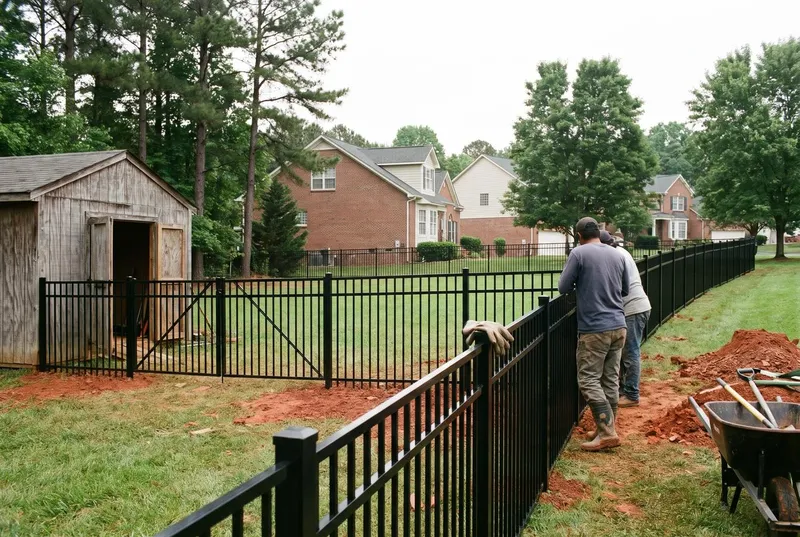
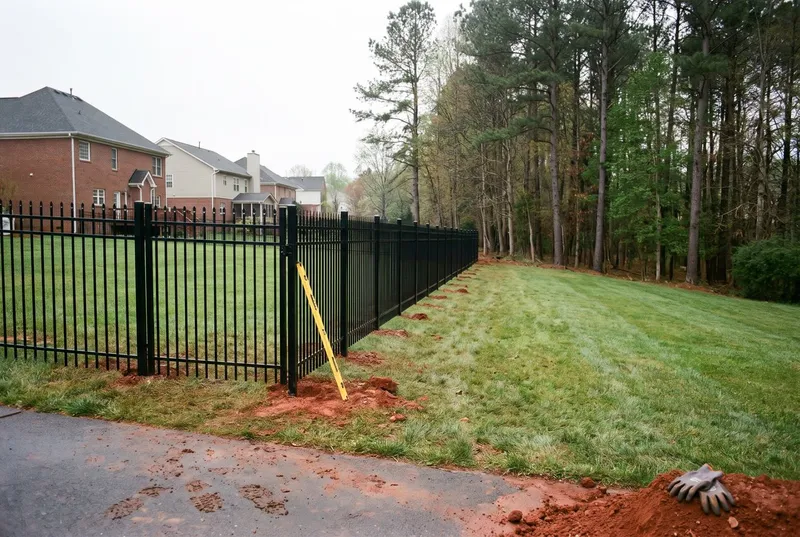
Five-foot black spear-top aluminum fence with a walk gate (sample photo)

Aluminum fence installation

Powder-coated aluminum in flat-top, spear-top and puppy-picket styles, four to six feet tall, black or bronze. Each panel racks up to about 24 inches over its eight-foot width, so a sloped Mint Hill lot gets a fence that hugs the ground instead of stepping down it with a gap under every section. The metal itself cannot rust. The coating carries a 15 to 20 year warranty, and the 48-inch height with four-inch picket spacing meets the pool code without a single change. Black is nine orders in ten here; bronze goes on the red-brick ranches where black reads too hard against the wall. Our view: on a lot that drops two feet from the house to the back line, aluminum is the first fence to quote, and usually the last one standing.
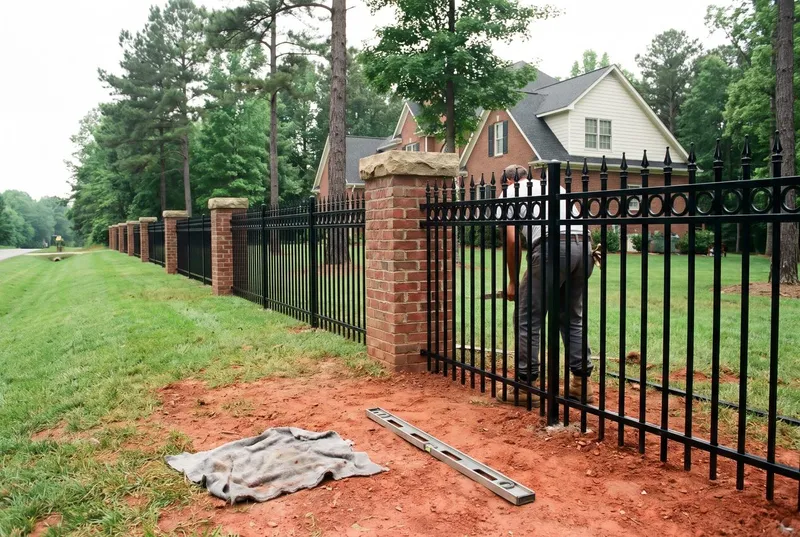
Black ornamental steel picket fence on brick columns along a road frontage (sample photo)

Ornamental steel and wrought iron fences

Galvanized, powder-coated steel pickets for the estate look: finials, rings, arched tops, and matching walk and drive gates that tie into brick or stone columns. Steel is heavy. A panel weighs about three times what aluminum does, so the posts go deeper and every corner gets a concrete footing. Worth it on a 300-foot road frontage on an acre lot, where the stiffness shows; on a backyard it is money spent on strength nobody will test. Rust-resistant coatings keep it black for decades with a hose and a rag.

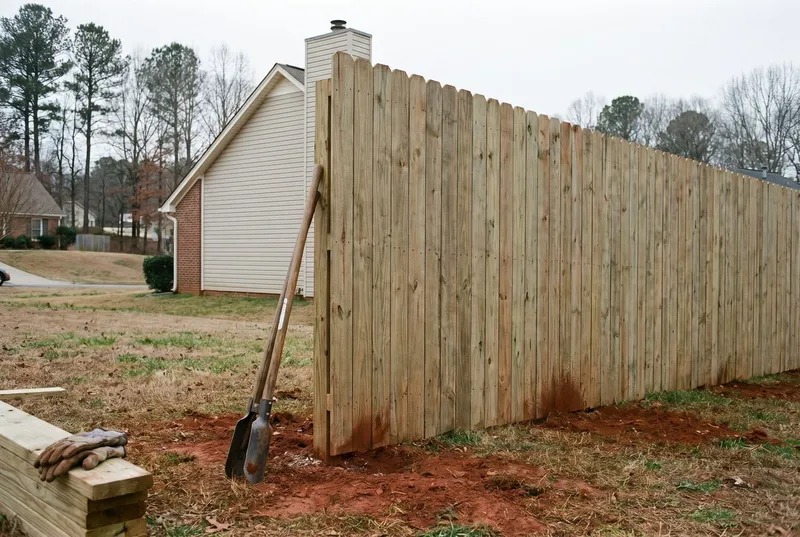
Six-foot pine dog-ear privacy fence in a 1990s subdivision backyard (sample photo)

Wood privacy fence installation

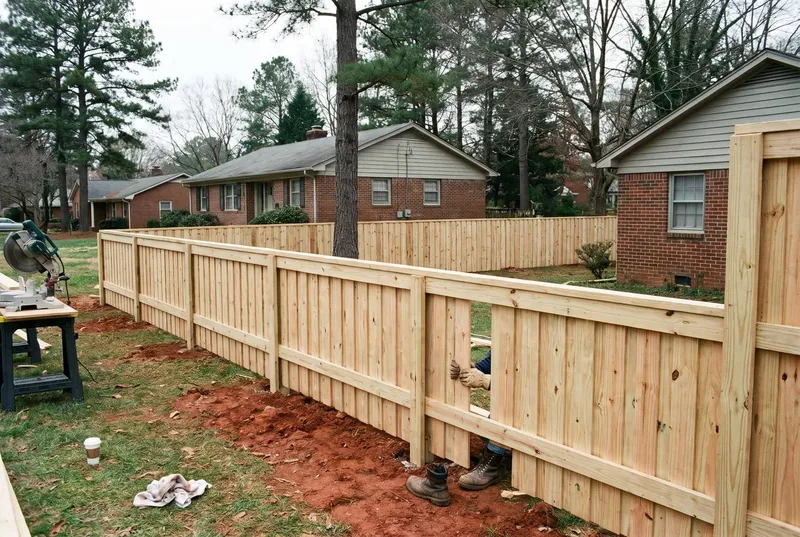
Six-foot privacy in pressure-treated pine or western red cedar, dog-ear or flat-top, with a cap rail where you want the finished look. Pine is still the most common fence in Mint Hill’s 1990s subdivisions. Most of those first fences are now 25 to 30 years old. The replacement goes in differently from the original: 6x6 posts at every corner and gate, a 2x6 kickboard at grade so the pickets never touch wet clay, and 3 rails instead of 2 on a six-foot panel. Cedar runs roughly a third more per foot, carries less weight on the posts, and the bugs leave it alone. We would rather see pine with a stain budget than cedar left to go grey.

Board-on-board pine privacy fence with a cap rail and trim on a corner lot (sample photo)

Board-on-board and capped privacy fences

Overlapping boards, a 2x6 cap and 1x4 trim, both faces finished. No gaps, ever. A plain privacy picket opens about a quarter inch in its first summer as the pine dries; board-on-board overlaps an inch and a half, so there is never a line of sight through it. It is the fence HOA boards say yes to on corner lots where both sides show, and it reads as the same fence from your yard and the street. Lumber runs about 20 percent more than dog-ear; the labor is the same day.

White vinyl privacy fence stepping to picket at the front corner (sample photo)

Vinyl privacy and picket fences

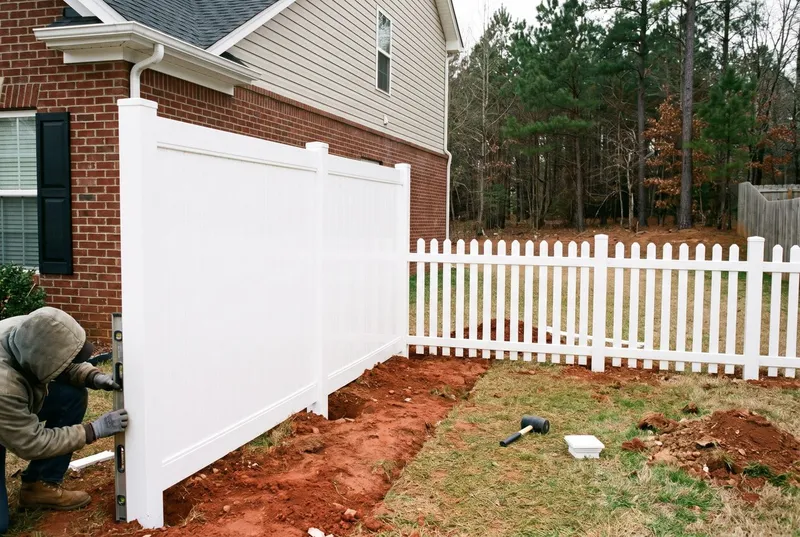
Virgin PVC with an aluminum channel inside the bottom rail, which is the difference between a panel that stays straight over eight feet and one that smiles by the second summer. Tongue-and-groove privacy boards at six feet behind the house, three- and four-foot picket out front, routed posts, UV inhibitors in the resin, and a lifetime manufacturer warranty on the color. Vinyl asks nothing of you. It does grow a green film on the shaded north side by year three, and a pressure washer takes it off in an hour. To be fair, it is also the most expensive panel to replace when a limb comes down on it.

Black vinyl-coated chain link fence along a side yard (sample photo)

Chain link fence installation

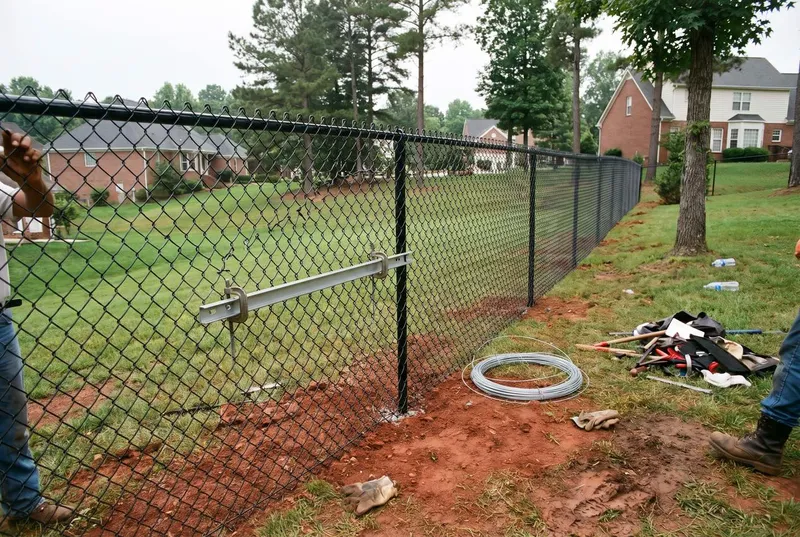
Galvanized or black vinyl-coated chain link in 9 and 11 gauge, four to six feet tall, for back yards, dog runs and commercial lots. Corner and gate posts go in concrete, the mesh is stretched to a top rail and a bottom tension wire so a dog cannot lift it, and slats go in the mesh when you need screening at a chain link price. It is the budget fence. Black vinyl-coated costs a dollar or two more a foot and disappears against the tree line; bare galvanized is what the 1980s lots still have, and honestly it is the fence we take out most often.

Black three-board horse fence with no-climb wire along a gravel lane (sample photo)

Horse fence, no-climb and acreage fencing

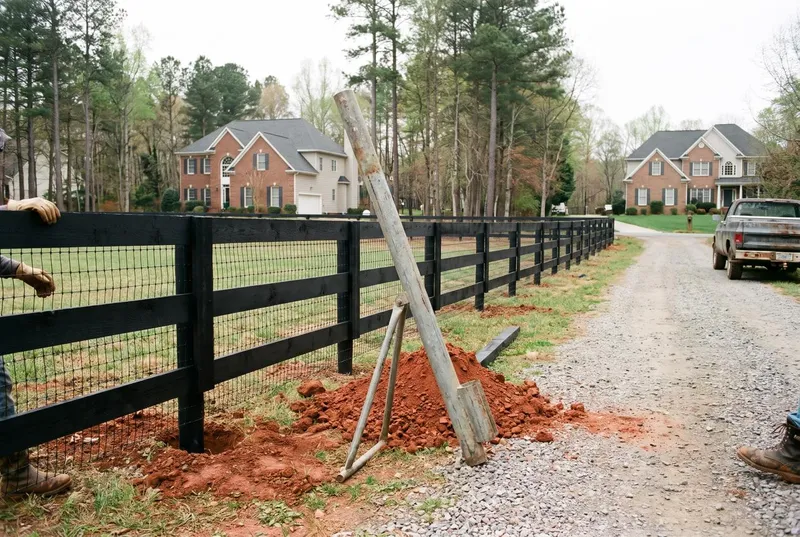
Three- and four-board oak or pine on the one-acre-plus lots toward the Cabarrus and Union lines, with 2x4 no-climb woven wire behind the boards for horses and dogs and an electric top strand where a horse leans. Line posts at eight-foot centers, 5-inch round posts driven rather than dug where the ground allows it, and the wire run on the pasture side of the boards. Twelve- and sixteen-foot tube gates at the drive and the barn. Runs are long out there. Priced and scheduled by the hundred feet; a 900-foot pasture is about a week for one crew.

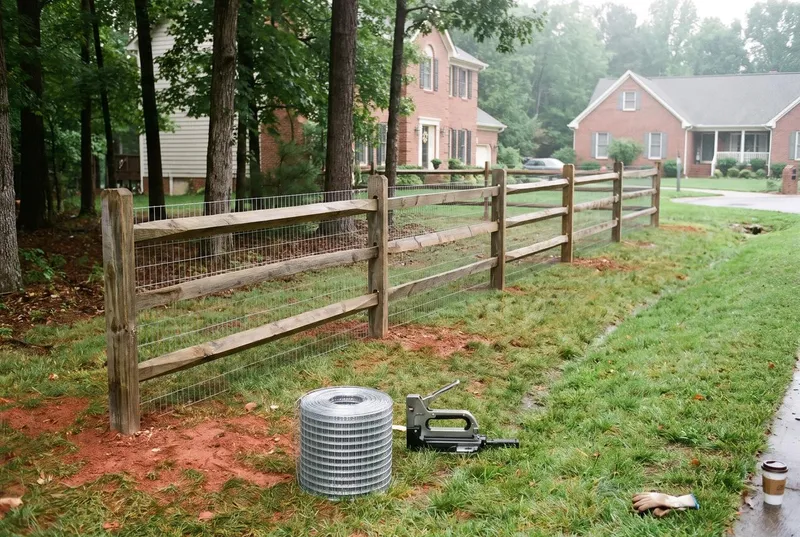
Two-rail cedar split rail fence with welded wire along a wooded front yard (sample photo)

Split rail and post-and-rail fences

Two- and three-rail cedar or locust split rail in ten-foot sections for property lines and front yards, welded wire behind it for children and dogs. Four feet is plenty. It meets the Town’s five-foot front-yard rule with a foot to spare, and the Town’s rule is the reason we quote split rail in front of so many wooded Mint Hill lots, where a privacy panel would be the wrong scale. Locust posts outlast cedar in wet clay by about ten years and cost a few dollars more each.

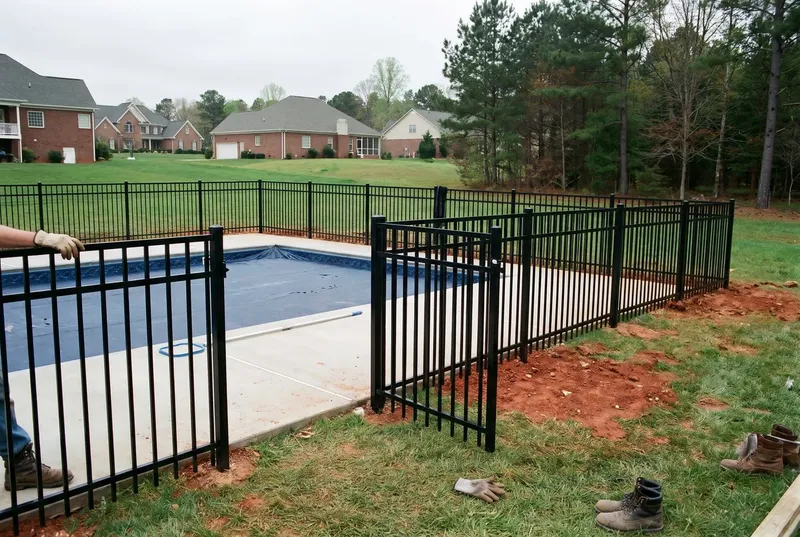
Black aluminum pool fence with a self-closing gate (sample photo)

Pool fence installation

The state’s residential pool barrier appendix sets the numbers: 48 inches tall at minimum, no opening a four-inch ball can pass through, and a gate that swings shut and latches by itself with the release 54 inches off the ground. Those numbers are not negotiable. Aluminum is the usual answer and removable mesh the second; both get built to those figures, and the Mecklenburg County inspection is scheduled before the crew leaves so the permit closes on one visit. It still surprises us how many builder-installed mesh barriers out here have the latch at 40 inches, where a six-year-old can reach it.

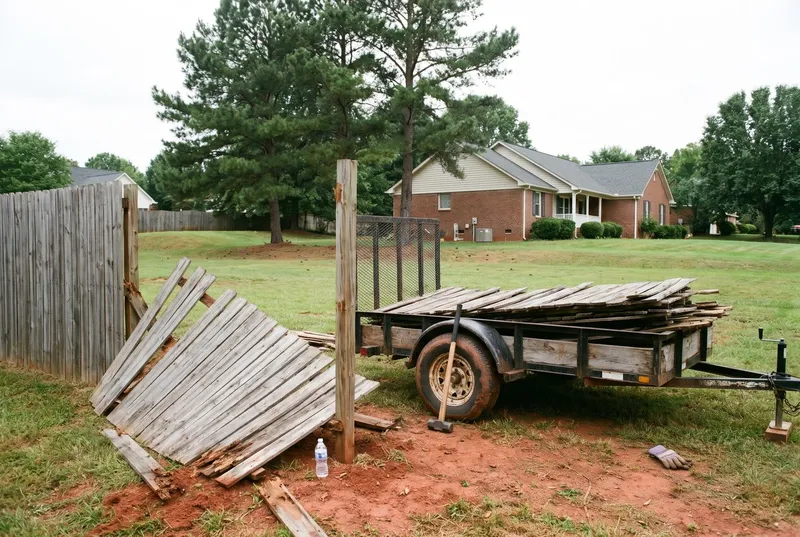
Rotted 1990s pine privacy fence half torn out and stacked in a trailer (sample photo)

Old fence replacement and tear-out

The pine privacy fences that went up with Mint Hill’s 1990s subdivisions are at the end of their life: posts rotted at grade, pickets loose, gates dragging. Posts go first. The clay holds water against the wood at grade, and the pickets above look fine for years after the post below has gone. Old wood, chain link or metal comes out, the concrete plugs come out of the ground with it, everything leaves on the trailer, and the new line goes in the same week with an HOA letter when the style changes. Removal runs about $3 to $5 a foot on a wood fence.

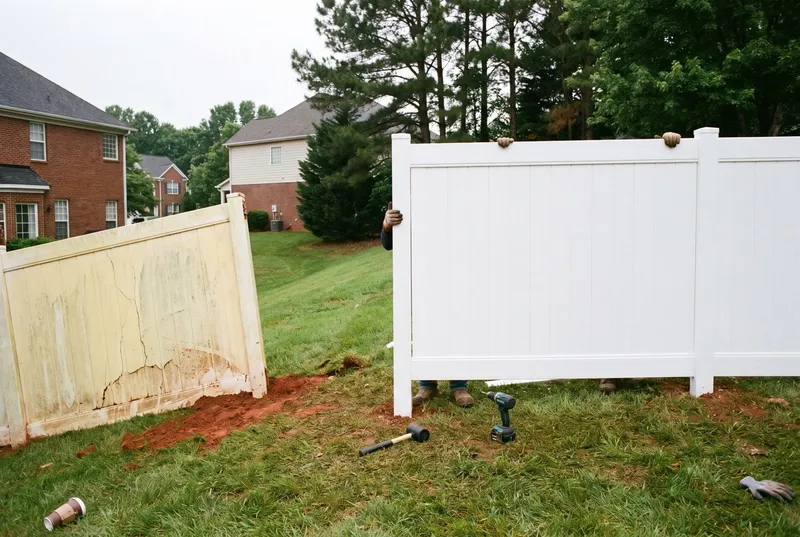
New vinyl privacy panel set beside a cracked old one (sample photo)

Fence repair: posts, panels and gates

Snapped or heaved posts after a wet winter in red clay, blown-out panels, rotted bottom rails and a gate that will not latch. We quote the repair line by line and say plainly when more than a third of the posts have failed and replacement is the cheaper path. Single-panel and single-post repairs are half-day jobs. A post reset runs a couple hundred dollars, which is why we would rather fix one post this spring than a whole run next spring.

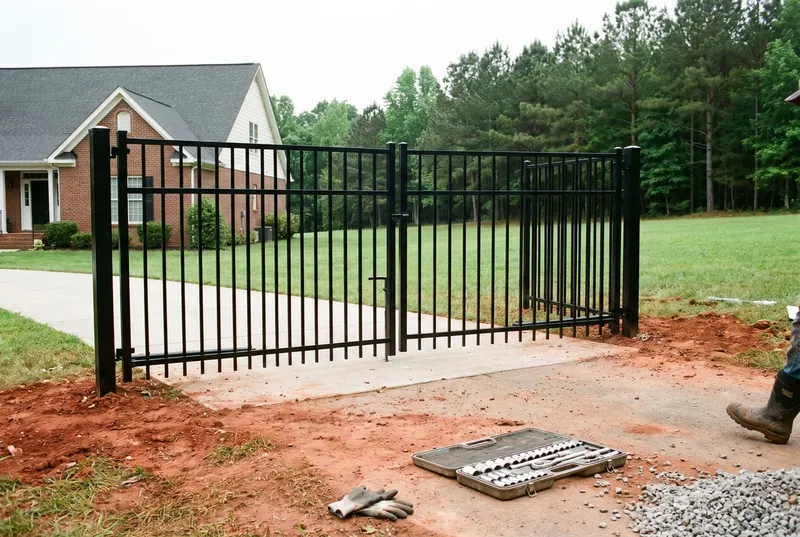
Double swing black aluminum driveway gate at a concrete drive (sample photo)

Driveway and estate gates

Ten- to sixteen-foot double drive gates in aluminum, steel or wood on welded steel frames, hung on 6x6 or 4-inch steel posts with drop rods and lockable latches. On a Mint Hill acre lot the drive gate is the first thing a visitor touches. Its posts go 42 inches down. A conduit goes in the trench now even if the keypad is a year away, because opening a finished drive twice is the expensive part. Walk gates to match, each one tuned to swing shut and latch on its own.

Specialty fence services

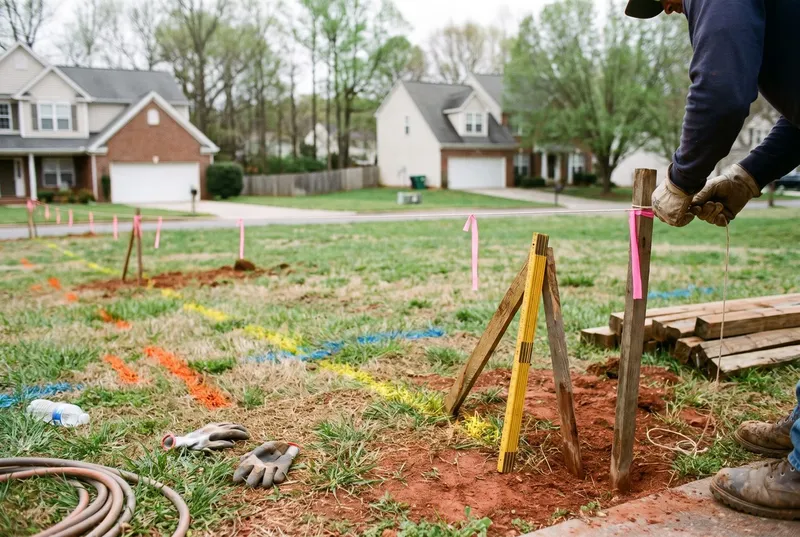
String line and flagging stakes along a front-yard fence line (sample photo)

Fence permits and height rules in Mint Hill

Five feet in front, seven on the sides and back outside the Downtown Overlay District, nothing in the right-of-way. Mecklenburg County issues the building permit, not Town Hall; the application, the plat sketch for the HOA and a call to the Town’s planners all happen before the quote is written.

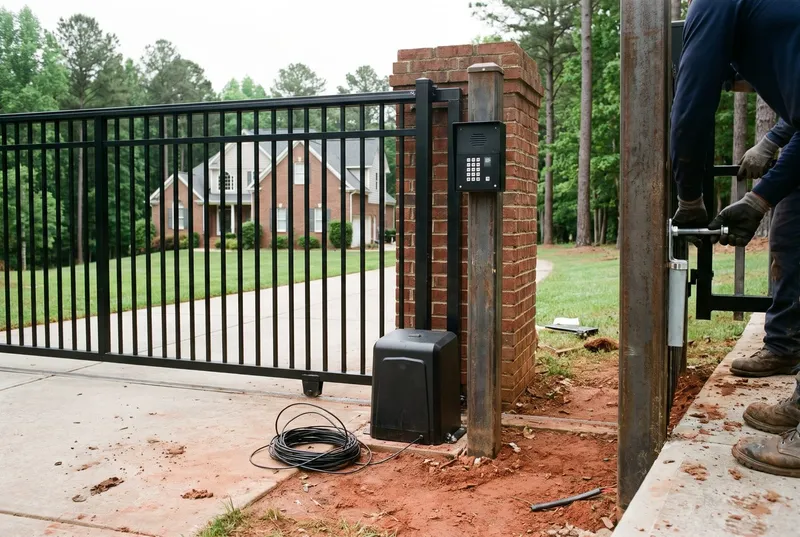
Keypad and intercom station beside a sliding aluminum driveway gate (sample photo)

Access control: keypads, intercoms and gate openers

Swing-arm and slide operators, keypads, intercoms and phone-app openers. Photo eyes and a safety loop in the drive are part of every install, not an option. Solar kits where the drive is far from power, which on an acre lot is most of them.

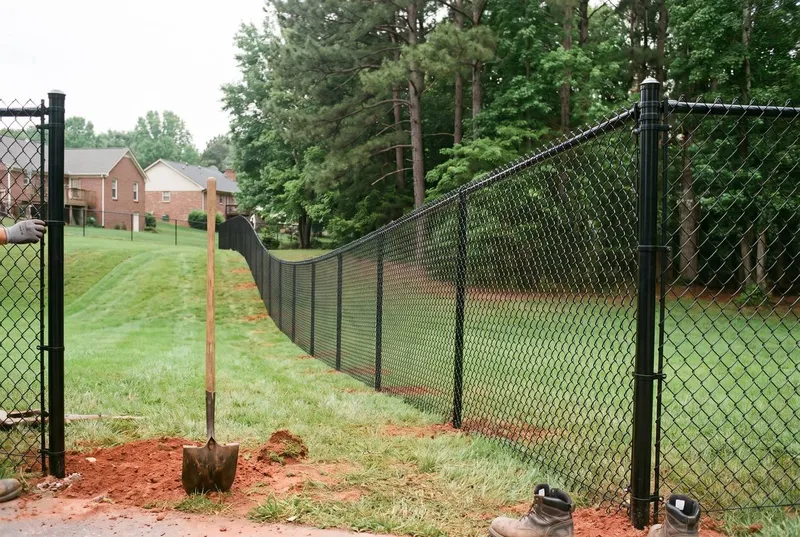
Chain link fence racked down a steep sloped backyard (sample photo)

Sloped and stepped fence lines

Racked aluminum and chain link that follow the grade, stepped wood and vinyl panels with the gap closed at the bottom, longer posts on the downhill side. Mint Hill rolls, and a fence that ignores it leaves a dog-sized hole under the last panel.

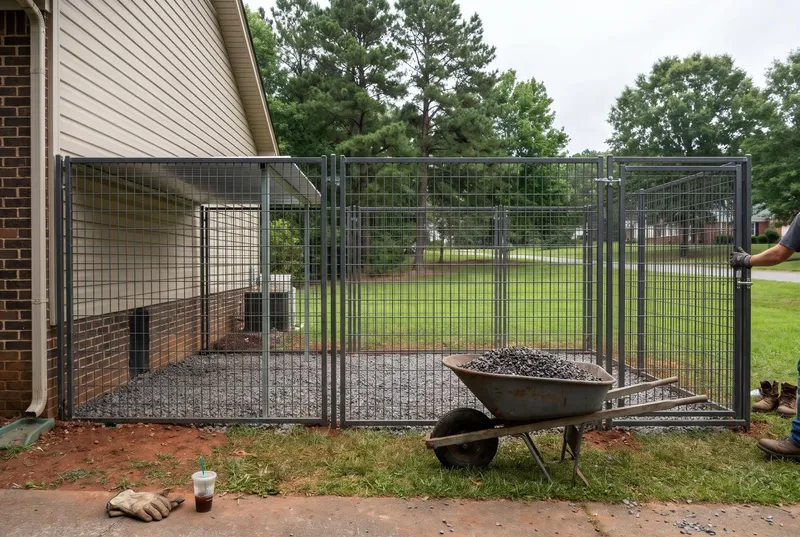
Welded wire kennel run with a gravel floor and a shade roof (sample photo)

Dog runs and kennel enclosures

Six-foot chain link or welded wire runs on a gravel or concrete pad, a 12-inch mesh skirt buried along the bottom for diggers, puppy pickets on aluminum and picket, and two-way latches a dog cannot work open. The breed sets the mesh: 2x4 openings hold a lab, a beagle wants 1x2.

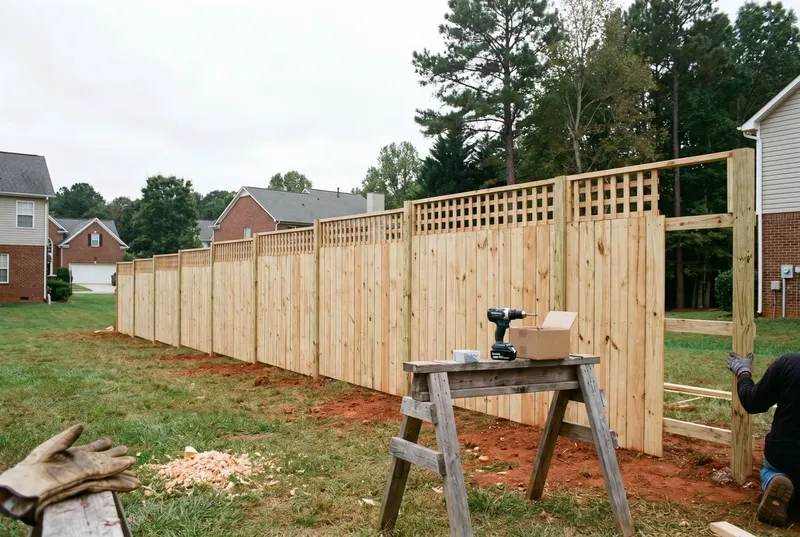
Lattice topper being added to a six-foot pine privacy fence (sample photo)

Lattice toppers, privacy screens and fence extensions

Adding 12 to 18 inches to a six-foot fence stays inside the Town’s seven-foot side-yard limit, which is the whole reason toppers are so common here. Lattice and horizontal-slat toppers, chain link privacy slats and windscreen, trellis panels for a vine.

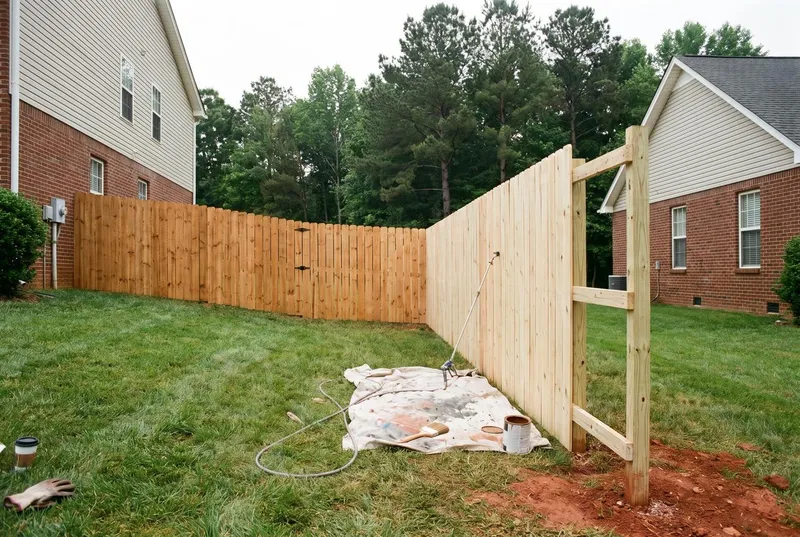
Pine privacy fence half stained in a semi-transparent cedar tone (sample photo)

Fence staining and sealing

Semi-transparent oil stain, sprayed on and worked in with a brush. A new pine fence is too wet to take stain for its first four to eight weeks; an older fence gets washed the day before. Count on a fresh coat every two to three summers to keep the grey out.

Commercial fencing in Mint Hill

Church, school and daycare fencing

Playground yards fenced to the licensing height with gates that latch themselves, parking-lot perimeter, ballfield backstops, aluminum at the entrance and chain link behind the buildings. One quote covers the whole campus, and the crew works around Sunday services and the school day.

Medical office and retail fencing

Dumpster enclosures, HVAC screening, patio railings and enclosures, bollards at the drive-through, and an aluminum perimeter that matches the building. After-hours installs so the parking lot stays open.

Farm and equestrian perimeter fencing

Board, no-climb and high-tensile runs by the thousand feet, sixteen-foot tube gates, cattle guards and a lane to the barn, on the farms along the Cabarrus and Union county lines.

Security fencing and gated enclosures

Six- and eight-foot galvanized chain link, barbed wire where the zoning allows it, cantilever slide gates, anti-climb ornamental steel and keypad entries for storage yards and utility sites.

Mint Hill fence rules: 5 feet in front, 7 feet on the sides and back, and who issues the permit

Mint Hill writes its own fence rule, and it is more generous than most of the towns around it. Outside the Downtown Overlay District a front-yard fence can stand five feet tall and a side or rear fence seven, which is why a six-foot privacy fence with a lattice topper is legal here when it would need a variance in Indian Trail. Nothing may sit in the street right-of-way, and the fence has to be placed so you can maintain it from your own side of the line.

The permit is the part that surprises people. The Town's planning office answers the zoning questions, but the building permit itself is issued by Mecklenburg County, so the application goes to the county portal, not Town Hall. Inside a subdivision the HOA letter comes first, because the county will ask for it.

Our Mint Hill fence installers settle the height, the setback and the permit path at the measure, draw the HOA sketch, and order nothing until the paperwork is back. The figures here follow the Town's published rule and get a confirming call to the planning office before every quote.

5 ftfront yard
7 ftside and rear
Outside the Downtown Overlay District. Permit from Mecklenburg County.
WhereLimitWho approvesTypical wait
Front yard5 feetTown zoning rule; county permitOne to two weeks
Side and rear yard7 feetTown zoning rule; county permitOne to two weeks
Downtown Overlay DistrictDifferent limitsTown planning officeAsk before the quote
Inside an HOAThe HOA's rule, if lowerHOA letter first, then the countyOne to three weeks

Why Mint Hill homeowners call us first

Six steps from measure to final gate swing

1

Measure and style walk

A walk of the whole line with a wheel and a plat, pin to pin, noting the slope, the trees in the way and where each gate wants to be.

2

Written quote in 24 hours

Every item priced on its own line: feet of fence, each gate, tear-out, slope work. Drop a line and the total drops with it.

3

Town rules and county permit

The height and setback are checked against the Town's rule, the HOA gets its sketch, and the county application goes in.

4

Locates and staking

NC 811 paints the utilities, the easements are confirmed on the plat, and the line is staked and strung before any digging.

5

Posts, then panels

Posts go in concrete one day and cure overnight; rails, pickets or panels hang the next, gates last.

6

Gates hung and walkthrough

Gates tuned to swing shut on their own, a magnet pass across the yard for dropped nails, and the warranty paperwork in your hand.

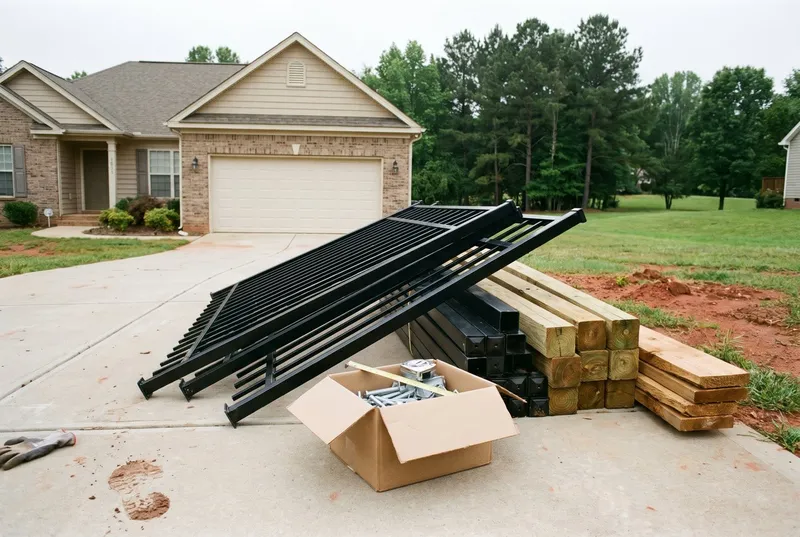
Aluminum panels, posts and pine lumber stacked on a Mint Hill driveway (sample photo)

Materials, grades and warranties

The metal lines are powder-coated aluminum and hot-dip galvanized steel. The wood lines are southern yellow pine treated for ground contact at the posts, and western red cedar where the boards will carry a clear stain. Vinyl is virgin PVC with an aluminum insert in the bottom rail; chain link is 9 or 11 gauge galvanized wire. Every screw, hinge and latch is stainless or hot-dip galvanized, because a $2 bright-zinc hinge is how a $9,000 fence starts to streak rust by year two. The manufacturer's warranty for each product comes to you in writing with the invoice.

Financing and payment

Larger projects can be financed through the contractor; mention it on the first call and the options come with the quote. Without financing it is a deposit when you sign and the balance at the walkthrough. Nothing is ordered until the county permit and any HOA letter are back.

What a fence costs in Mint Hill

Price follows the material, the length and what is in the way. Aluminum and steel cost more per foot and last longest; pine is the value pick. The table prices a six-foot residential fence at 150 and 200 feet, the two lengths most Mint Hill backyards land on. Gates, slopes, tear-out and extra corner posts move the number.

MaterialInstalled, per linear foot150 feet200 feet
Aluminum, four to five foot$40 to $70$6,000 to $10,500$8,000 to $14,000
Ornamental steel$60 to $110$9,000 to $16,500$12,000 to $22,000
Wood privacy, six foot$28 to $45$4,200 to $6,750$5,600 to $9,000
Vinyl privacy$35 to $60$5,250 to $9,000$7,000 to $12,000
Chain link, four to six foot$15 to $30$2,250 to $4,500$3,000 to $6,000
Horse board, three rail$18 to $30$2,700 to $4,500$3,600 to $6,000

Typical Charlotte-area residential ranges. Your written quote replaces them.

Recent fence projects in Mint Hill

Sample projects showing the format. Replaced with the contractor's confirmed jobs at intake.

Four-foot black aluminum fence around a sloped backyard with a double gate (sample photo)

Black aluminum backyard fence, Mint Hill

Sample: 160 feet of four-foot flat-top aluminum around a sloped backyard, racked panels, one walk gate and a ten-foot double gate to the shed.

Aluminum, about $8,500

Six-foot board-on-board pine privacy fence with a cap rail (sample photo)

1990s pine fence replaced, Matthews

Sample: 190 feet of rotted dog-ear privacy torn out and hauled, replaced with six-foot board-on-board pine on 6x6 corners, HOA letter included.

Wood privacy, about $7,900

Black three-board horse fence with no-climb wire along a pasture (sample photo)

Three-board horse fence, Bain School Road

Sample: 900 feet of three-board pine with no-climb wire and an electric top strand around a two-acre pasture, two sixteen-foot tube gates.

Horse fence, about $19,000

Request a written quote

(704) 555-0100Monday to Saturday, 7:30 am to 6 pm
Talk to a fence contractor

Request a written quote

No charge for the measure. Your written quote arrives within 24 hours of the visit.

Say which fence you are thinking of and roughly how many feet, and a local contractor calls the same business day to book the measure. The written quote lands within 24 hours of that visit.

Each line of the quote stands on its own, material, footage, gates and tear-out, so you know what moves the price before a hole is dug, and nothing is ordered until the county permit and any HOA letter are back.

Every request is answered by phone first. If you would rather text, say so in the message.

Serving Mint Hill and surrounding areas

Mint Hill is the home base; the same crew covers the subdivisions off Lawyers Road and Matthews-Mint Hill Road, the acreage along Bain School Road, and the towns just over the Cabarrus and Union county lines.

Mecklenburg County

  • Mint Hill
  • Matthews
  • Hickory Grove
  • East Charlotte

Cabarrus, Union and Stanly

  • Harrisburg
  • Midland
  • Stallings
  • Indian Trail
  • Locust

Fence FAQ

How tall can my fence be in Mint Hill?

Five feet in the front yard and seven feet in a side or rear yard outside the Downtown Overlay District, by the Town's own rule. An HOA can set a lower limit for its streets, and the HOA rule wins inside the subdivision.

Who issues the fence permit, the Town or the county?

Mecklenburg County issues the building permit; the Town of Mint Hill's planning office answers the zoning questions. We prepare the application and confirm the current requirement before the quote.

How much does an aluminum fence cost per foot?

About $40 to $70 per linear foot installed for four- to five-foot residential aluminum, so a 150-foot backyard runs $6,000 to $10,500 before gates. Your written quote replaces these ranges.

Is aluminum or steel better for an estate fence?

Aluminum never rusts, racks to a slope and costs less; ornamental steel is heavier, stiffer over long runs and takes finials and rings better. Long road frontage on an acre lot usually goes steel; a backyard goes aluminum.

How much does 200 feet of privacy fence cost?

Six-foot wood privacy lands around $5,600 to $9,000 for 200 feet; the same run in vinyl is $7,000 to $12,000 and in chain link $3,000 to $6,000. Gates and tear-out are extra lines on the quote.

How deep do you set posts in clay?

30 to 36 inches, which puts the footing under the layer of clay that swells and shrinks with the seasons. The hole gets gravel at the bottom for drainage and concrete around the post; corners and gates get a 6x6 or a steel post.

How long does a backyard take?

One to two days for most backyards once the permit is in hand. Add a day for a long run, a steep slope or a tear-out; a pasture is a week.

Can you fence a sloped yard without gaps?

Yes. Aluminum and chain link rack to follow the grade; wood and vinyl step down the slope with the gap closed at the bottom and longer posts on the downhill side.

Can you replace my 1990s fence and haul it away?

Yes. We tear out the old fence, break out the concrete footings, haul everything, and set the new line the same week. If the style changes inside an HOA we prepare the letter.

Does my pool fence meet NC code?

The checks are height (48 inches minimum), openings (nothing a four-inch ball passes through) and the gate (swings shut and latches by itself, release 54 inches up). The barrier is built to those figures and the county inspection is booked before the crew leaves.

What does horse fencing cost per hundred feet?

About $1,800 to $3,000 per hundred feet for three-board pine with no-climb wire, before gates. Tube gates, an electric strand and clearing move the number.

When can a new pine fence be stained?

Give new pressure-treated pine four to eight weeks to dry out before stain goes on, longer in a wet spring. Cedar is ready sooner.

Do you offer financing?

Yes, on larger projects, through the contractor who does the work. Mention it on the first call and the options come back with the quote.

Which towns do you serve?

Mint Hill, Matthews, Stallings, Harrisburg, Midland, Locust, Indian Trail, Hickory Grove and east Charlotte.

Ready for a fence that outlasts the one it replaces?

The measure is free and the quote is written, 24 hours after the visit.

Call (704) 555-0100Free quote